Mr. White
The Monkey's PawMr. White is the father whose modest wish for two hundred pounds is fulfilled through Herbert’s death, making him the central figure in the story’s collision between domestic hopes and consequences no one can control. His successive responses to the monkey’s paw—curiosity, reluctant belief, grief, resistance, and desperate action—trace a movement from casual play with an uncanny object to an attempt to prevent its final horror from entering the house.
Identity and Domestic Life
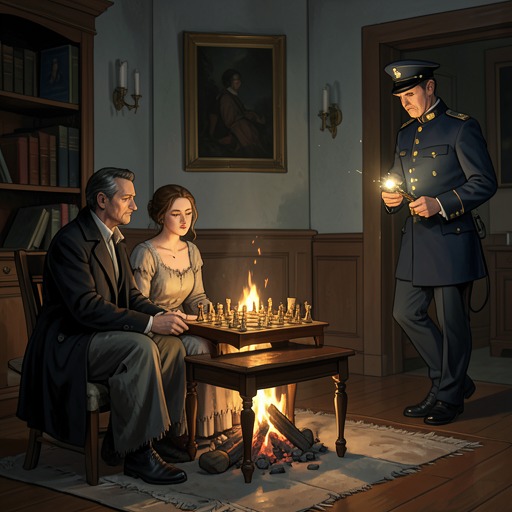
At the beginning, Mr. White is at home with his wife and son on a cold, wet night. In the small parlour of Laburnam Villa, the blinds are drawn and the fire burns brightly as he and Herbert play chess. Mr. White’s way of playing involves radical changes that put his king in sharp, unnecessary danger; his wife, knitting placidly by the fire, comments on the peril. The chess game quietly anticipates the risks that will shape his decisions: he sees a fatal mistake too late, and tries to distract Herbert from noticing it by drawing attention to the wind.
This domestic setting gives his later choices their particular weight. Mr. White is not introduced as a man driven by grand ambitions. When he takes out the paw, he admits that he does not know what to wish for and feels that he already has what he wants. Herbert turns the family’s practical strain into a joking proposal: if the house were cleared, his father would be happy, so he should wish for two hundred pounds. The amount is presented as sufficient to settle a household difficulty, not as a fortune that would transform the family into emperors or make them famous.
Encounter with the Paw
When Sergeant-Major Morris produces the object, it is described as an ordinary little paw, dried to a mummy. Mrs. White draws back with a grimace; Herbert accepts it and examines it curiously; Mr. White takes it from his son, examines it, and places it on the table. His attention shifts from its appearance to its claimed power. Morris explains that an old fakir put a spell on it to demonstrate that fate ruled people’s lives and that interference with fate brought sorrow. The spell allows three separate men three wishes each.
The tale of the first owner makes the warning concrete. He used all three wishes, and his third was for death; Morris says that this is how he acquired the paw. When Mr. White asks whether Morris would take another three wishes if he could, Morris can only say that he does not know. He then throws the paw onto the fire. Mr. White gives a slight cry, stoops, and snatches it away. The rescue is an early act of choice: even after hearing the warning and seeing Morris destroy the object, he wants to keep it, asking for it if Morris does not want it. His conduct does not prove that he believes the story fully, but it shows that curiosity and possibility outweigh caution.
The First Wish and Its Cost
Before making a wish, Mr. White looks at the paw dubiously and says that he has no clear desire. Herbert supplies the idea and treats the situation as a joke, even playing a few solemn chords on the piano as his father holds up the talisman. Mr. White then wishes distinctly for two hundred pounds. The performance still carries the air of a family amusement—until a crash from the piano is interrupted by Mr. White’s shuddering cry. The paw has moved and lies on the floor. He looks at it with disgust, and the wish’s apparent absurdity acquires a physical, unsettling sign.
The money comes by way of a messenger from Maw and Meggins. The visitor says the firm disclaims all responsibility for Herbert’s accident but wishes, in consideration of his service, to present the family with compensation. When Mr. White asks how much, the answer is two hundred pounds. The exact sum he named is thus returned not as uncomplicated prosperity but as payment following his son’s death. On hearing it, he unconsciously drops his wife’s hand, rises, stares at the visitor in horror, and shapes the question with dry lips. He then smiles faintly, reaches out like a sightless man, and collapses unconscious, while his wife shrieks. The coincidence binds his wish to the loss in the family’s experience, whatever the visitor’s account of the accident establishes about its cause.
Grief and the Second Wish
After Herbert is buried in a cemetery some two miles away, Mr. White and his wife return to a house steeped in shadow and silence. Their first expectation that something might still happen gives way, over the days, to resignation and weary quiet. About a week later, Mr. White wakes in the dark and discovers that his wife is no longer beside him; her subdued weeping comes from the window. The household’s earlier warmth has narrowed into a shared bereavement that neither can relieve.
When his wife insists that the paw can grant two wishes still and demands that he wish their son alive again, Mr. White calls her mad and resists. He knows a fact she is not then weighing: Herbert has been dead for ten days, and the body was so mutilated that he could identify his son only by his clothing. He warns her that, if Herbert was too terrible for her to see at the time, she should consider what a return might mean now. His objection is not a denial of their grief but fear of the bodily consequence that the wish might bring. His wife answers with the conviction of a mother who does not fear the child she nursed, and drags him toward the door to make him retrieve the paw.
Mr. White goes down in darkness to the parlour and finds the talisman on the mantelpiece. As he searches his way back, he fears that the unspoken wish could bring his mutilated son before he can escape the room; he loses his sense of the door’s direction and gropes along the wall until he reaches the passage with the paw in his hand. Back upstairs, he calls the wish foolish and wicked, but his wife repeats her demand. He raises his hand and wishes his son alive again. The talisman falls to the floor. His wife goes to the window and raises the blind, while he sits trembling and watches her wait. The candle gutters out; he feels relief that nothing has happened, and returns to bed. The silence that follows does not resolve whether the wish has failed or merely delayed its consequence.
The Knocking and Final Wish
In bed, Mr. White and his wife lie listening to the clock. After a stair creaks and a mouse scurries through the wall, he gathers the matches and goes downstairs for a candle. At the foot of the stairs, his match goes out; as he pauses to strike another, a quiet, stealthy knock sounds at the front door. He drops the matches and stands motionless until the knock comes again, then hurries back upstairs and shuts the bedroom door. A third knock carries through the house. His wife starts up and asks what it is; the repeated sound turns her expectation into action as she breaks free and runs downstairs.
Mr. White follows only as far as the landing. He hears the chain rattle, the bottom bolt being drawn, and his wife calling that she cannot reach the bolt. While she searches for a way to open the door, he is on his hands and knees groping wildly for the paw. The knocking has become a perfect fusillade, and his wife puts a chair in the passage against the door; he hears the bolt slowly coming back. His effort is now a race against the opening, not a renewed attempt to fulfil his wife’s hope. He finds the paw at the last moment and frantically makes his third and final wish.
The knocking ceases suddenly, though its echoes remain in the house. Mr. White hears the chair drawn back and the door opened; a cold wind rushes up the staircase, followed by his wife’s long wail of disappointment and misery. He runs down to her and then on to the gate. The street lamp opposite flickers over a quiet, deserted road. The ending leaves the object of the second wish unshown, but Mr. White’s final intervention prevents the anticipated return from entering the family home. The two hundred pounds that began as a practical household wish has passed through compensation and bereavement to the threshold of an ordeal he chooses to stop.